

Keeping Your Pet’s Teeth Healthy at Home: Brushes, Wipes, Gels, and What Actually Works
Good dental care for your pet does not begin and end at the veterinary clinic. What happens at home between professional cleanings has a major impact on whether your pet develops gum disease, loses teeth early, or carries chronic infections that can affect their overall health. The tricky part is knowing where to start. Between toothbrushes, finger brushes, dental wipes, enzymatic gels, water additives, and dental chews, the options can feel overwhelming.
At Wales Animal Clinic, our personal approach to care means we take time to understand your pet’s temperament, species-specific needs, and your daily routine before recommending a dental home care plan. Our dental care services include professional cleanings and assessments, and we are always happy to demonstrate techniques and recommend products tailored to your individual pet. Contact us to schedule a dental evaluation or to discuss how to get started with home care.
Why Home Dental Care Has Real Clinical Impact
Periodontal disease begins the moment bacteria form a sticky film called plaque on tooth surfaces. Without mechanical disruption, that plaque mineralizes into tartar within days. Tartar irritates the gum tissue, bacteria accumulate in the pockets between the gum and tooth root, and the resulting infection destroys the bone and connective tissue that hold teeth in place. Left unaddressed, this process leads to tooth loss, painful oral abscesses, and bacteria that can enter the bloodstream and affect the kidneys, liver, and heart.
Professional dental cleanings under anesthesia address the disease that has already developed, including below the gumline where home care cannot reach. Home care slows the return of plaque after a professional cleaning, extending the time between procedures and reducing the overall disease burden throughout your pet’s life. The two work together. Our wellness and prevention program includes regular dental evaluations to monitor where your pet stands and what level of home care is needed.
What Pet Dental Products to Avoid
The shelves at the pet store are filled with products containing broad marketing claims for cleaner teeth and fresher breath. Here’s the honest truth: If the label says that a miracle spray or powder removes tartar, and shows images of teeth that were brown before and shiny white after- they’re lying. Nothing except a professional cleaning removes hardened tartar on teeth.
Beware of toys and chews that are harder than teeth. The critical safety rule: if pressing your thumbnail into the chew does not leave a dent, it is too hard and risks fracturing teeth. Dangerous chew items include antlers, hooves, hard nylon bones, and raw bones. Safe chew toys flex under pressure and are designed to contact tooth surfaces effectively.
The VOHC Seal: Your Shortcut to Evidence-Based Products
VOHC-accepted products carry a seal from the Veterinary Oral Health Council, an independent organization that reviews clinical trial data before granting recognition. Only products that demonstrate measurable plaque or tartar reduction in controlled studies earn the seal.
The absence of a VOHC seal does not automatically disqualify a product, but its presence provides reliable confidence that the claim on the label reflects what the product actually does. Look for the VOHC seal when evaluating dental chews, water additives, gels, wipes, and diets. Our team can guide you toward VOHC-accepted products that are appropriate for your pet’s size, temperament, and oral health status.
Toothbrushing: The Gold Standard
Why Brushing Is the Most Effective Option
Toothbrushing physically disrupts the bacterial biofilm before it has time to mineralize. No other home care method matches it for effectiveness when done consistently. Daily brushing provides the highest level of protection. Every-other-day brushing still delivers meaningful benefits. Consistency over perfection is the right frame of mind.
Getting Started Without Creating a Battle
The introduction is where most home brushing routines succeed or fail. Rushing the process creates negative associations that are very difficult to reverse. A patient, gradual approach produces a pet who tolerates, and sometimes even looks forward to, the routine.
A sensible progression:
- Spend a few days touching the muzzle and lifting the lips gently, with a small reward after each session
- Run a clean finger along the outer tooth surfaces and gumline
- Introduce a small amount of pet-safe enzymatic toothpaste on a fingertip and let them taste it
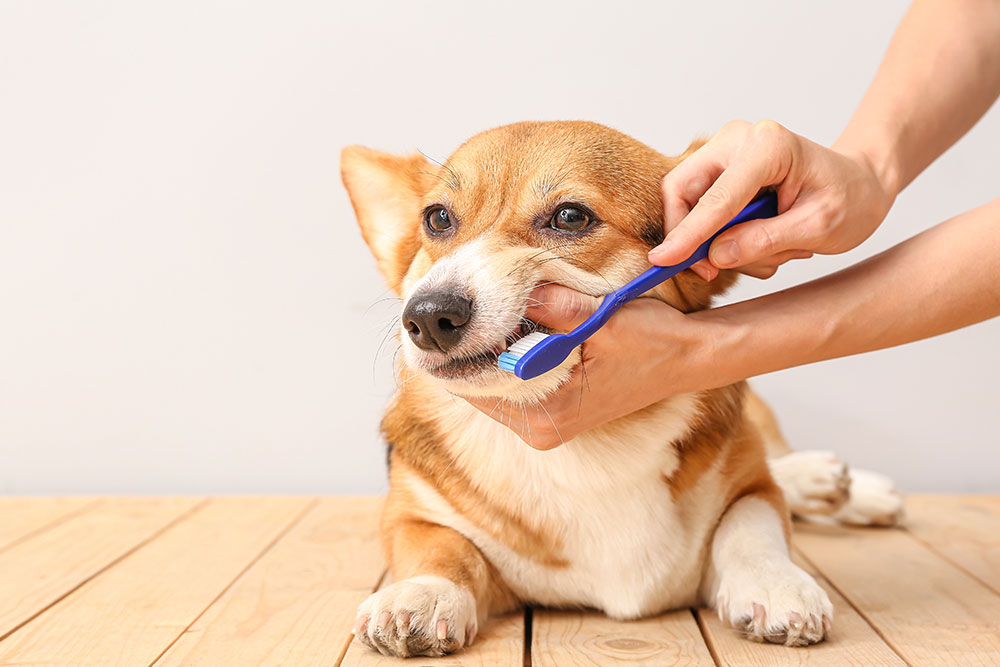
- Move to a fingerbrush or soft-bristled toothbrush, starting at the front teeth
- Gradually extend further back, one area at a time, over the following days
Cooperative care techniques that emphasize consent and positive reinforcement throughout the process dramatically improve how pets accept handling, including mouth handling.
For brushing dog teeth, hold the brush at a 45-degree angle toward the gumline and use short circular or back-and-forth strokes, focusing especially on the upper back teeth where tartar accumulates fastest.
For brushing cat teeth, smaller brushes, lighter pressure, and shorter sessions work better than extended attempts. Cats are often more tolerant when they feel stable rather than restrained.
Never use human toothpaste. Fluoride is toxic to pets, and xylitol, found in many human oral care products, is extremely dangerous. Use only enzymatic or pet-formulated products. Our online pharmacy carries enzymatic toothpaste and toothbrushes for pets.
When Brushing Is Not an Option: Wipes and Gauze
For pets who genuinely will not tolerate a brush, dental wipes or gauze wrapped around a finger provide friction-based plaque removal on accessible surfaces. They are more limited than brushing because they cannot reach gumlines or the inner surfaces of back molars, but used consistently and paired with an enzymatic product, they provide meaningful benefit.
Dental wipes are practical for front teeth, canines, and the outer surfaces of the back teeth. They are a realistic long-term solution for some pets and households, not just a stepping stone.
Our team can help you figure out whether wipes are an appropriate starting point for your pet or a realistic long-term strategy based on their temperament and the current state of their dental health.
Enzymatic Gels, Powders, and Sprays
Enzymatic products work chemically by targeting bacterial biofilm without requiring physical scrubbing. Products containing enzyme systems such as lactoperoxidase and glucose oxidase can be applied with a finger, a brush, a spray, or added to food. Many require no rinsing, making them easier to use than brushing for resistant pets.
Dental care powder can be sprinkled directly onto food, providing passive enzymatic protection every meal. Combining enzymatic options with wipes or brushing produces better outcomes than either approach alone, because you get both mechanical disruption and ongoing chemical action.
Water Additives and Oral Rinses
Water additives deliver antimicrobial or enzymatic ingredients passively through drinking, making them the most hands-off option available. Vetradent water additive and CET Aquadent are veterinary-trusted options that simply go into the water bowl each time it is filled.
Keep in mind that water additives cannot remove tartar that has already formed, and their effectiveness varies. Introduce them gradually at a lower concentration than recommended on the label to ensure your pet does not stop drinking. Ask our team before selecting a product to confirm it is appropriate for your pet’s current oral health.
Dental Diets
Dental diets are formulated so that teeth must penetrate the kibble before it crumbles, producing mild cleaning with every bite. Some formulations also include ingredients that bind calcium and slow tartar mineralization. Like all home care tools, dental diets complement professional care rather than replacing it.
Our pharmacy carries cat dental diets and dog dental diets for pets whose oral health would benefit from this approach.
Dental Chews and Toys
Chewing action physically scrapes plaque from tooth surfaces, and the right chew adds genuine benefit to a home care routine. Dental chew toys with textured surfaces that reach between teeth provide better mechanical cleaning than flat or smooth chews. Edible dental chews provide both mechanical and enzymatic action simultaneously.
Browse our online pharmacy for vet-trusted dog dental chews and treats selected for safety and effectiveness, and a full range of dog dental and cat dental products. Our team can help you match the right chew to your pet’s size, chewing habits, and digestive tolerance.
What Home Care Cannot Replace
Even the most diligent home routine cannot remove tartar that has already hardened, and it cannot address the subgingival disease, infection and bone loss below the gumline, that only anesthesia-based cleaning allows us to access and treat.
Anesthesia-free dental risks are worth understanding: procedures done without anesthesia can only address visible surfaces and cannot reach the subgingival area where most clinically significant disease lives. They create the appearance of cleaner teeth while leaving the most important disease untouched.
Our dental care services include full-mouth dental radiographs, scaling and polishing above and below the gumline, and the kind of thorough examination that only anesthesia makes possible. Our surgery and anesthesia protocols prioritize safety with pre-anesthetic evaluation and monitoring throughout.
Home care earns longer intervals between professional cleanings. It does not make those cleanings optional.
Building a Routine That Actually Sticks
The most effective dental routine is the one that happens consistently in your home. A few things that make consistency more realistic:
- Pair dental care with an existing daily habit, such as the last activity before bed or immediately after the evening meal
- Keep supplies somewhere visible, not in a cabinet that requires effort to access
- Start small and build: even 30 seconds of an enzymatic gel applied to the gumline daily is producing benefit
- Involve everyone in the household so the routine does not collapse when schedules vary
- Have a backup plan: on days you can’t brush, give a dental chew or use a dental powder- anything is better than nothing
Our team is happy to coach owners through specific challenges, demonstrate techniques, and troubleshoot whatever is not working. Great medicine is about personalized care, including the details of your individual pet’s temperament and your household’s realistic capacity for home care.

Frequently Asked Questions About Home Dental Care
How do I know if my pet’s home care is working?
Improving breath quality, less visible tartar at the gumline between appointments, and less gum redness are all positive signs. At each dental evaluation, our team can assess how much tartar has accumulated since the last cleaning and advise whether the current routine is sufficient.
My pet hates having their mouth touched. Where do I start?
Start with products that don’t require handling of the mouth: put enzymatic toothpaste on a chew toy, or dental powder on their food so they get used to the taste. From there, work toward finger contact with the lips and gums before introducing any implement. Some pets take weeks or months to progress. Any improvement is progress worth making.
How often do pets need professional cleanings?
Most pets benefit from annual professional cleanings, with some small breeds and cats benefiting from more frequent care.
Are dental treats enough on their own?
For pets who cannot tolerate any other form of home care, VOHC-accepted treats provide more benefit than nothing. But brushing or enzymatic products in addition to treats always produces better outcomes than treats alone.
A Partnership in Lifelong Dental Health
The bond you share with your pet is what drives the effort of home dental care, and that effort pays off in fewer painful dental problems, less need for extensive treatment, and more comfortable years together. At Wales Animal Clinic, we are here to guide you toward the approach that fits your pet’s personality and your daily life.
Contact us to schedule a dental evaluation, get a product recommendation, or have our team demonstrate proper brushing technique. Your pet’s dental health is part of the whole picture we care about.

Leave A Comment